





Holding the Line: Advocating for just energy transitions amid democratic backsliding
New synthesis report based on the takeaways of a three part webinar series on the rights-respecting way forward towards a decarbonized energy transition.
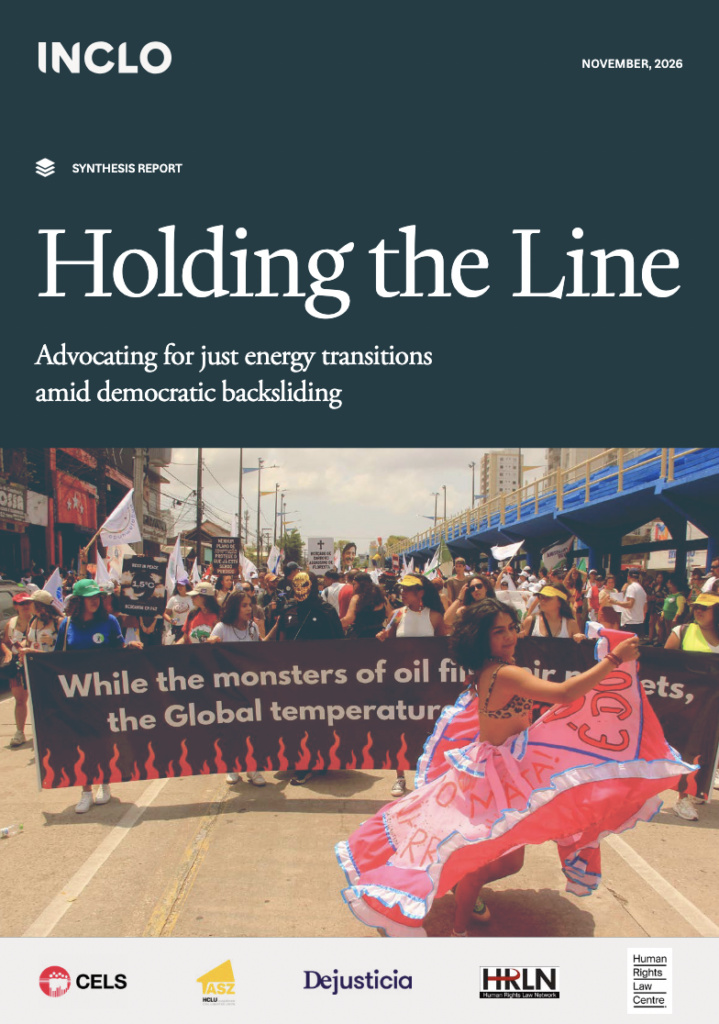
We seem to be witnessing a paradox: institutional and legal progress toward just transitions is unprecedented, while the geopolitical context seems to distance us from translating those standards into reality. To explore that tension and the possibilities around it, INCLO organized a series of public webinars, Holding the Line: Advocating for just energy transitions amid democratic backsliding, which yielded the conclusions contained in this new report.
These were three conversations between INCLO members from Argentina, Australia, Colombia, Hungary, and India, along with experts from academia and civil society, in the lead-up to COP31 and the second Fossil Fuel Conference in Tuvalu. The combination of local and global perspectives opened discussions on possible pathways to bring global advances on just transition into national and local contexts, amid democratic challenges.
Each session addressed a crucial aspect of the transition: governance, finance, and human rights. In the first conversation, The governance of just energy transitions, the speakers analyzed key developments since the Paris Agreement and different kinds of national policies put in place to safeguard just transitions. The conversation then zoomed in on the challenges of Indigenous and community participation in Argentina and Hungary.
The second session, Who pays, who decides?, focused on the financial aspect of energy transitions: How can we fund the transition equitably? What pathways are possible given the current democratic challenges we face in multilateral and national contexts? The speakers highlighted debt relief, economic diversification, and progressive taxation as key components of funding a just transition. The conversation also covered the barriers faced by fossil fuel-dependent countries, such as Colombia, and the need for international cooperation to ensure equitable financing.
Finally, the session Human Rights as a compass for just energy transitions used recent advisory opinions on climate change as a starting point to explore how to translate human rights principles and obligations into concrete practices, particularly in contexts of democratic challenges. The panel explored strategies and successful experiences worldwide, particularly in Australia and India, to seize the transition as an opportunity to close inequality gaps.
This report synthesizes the main ideas and proposals that came up during the three sessions. Through this effort, we aim to bring together local and global reflections on the challenges we face today, while also shedding light on potential avenues to keep advocating for a transition centered on people’s rights.
INCLO thanks the media outlet Mongabay and journalists David Akana and Justin Catanoso for their support in the moderation of the series, as well as the speakers who generously participated in the discussions: Ayshka Najib, Peter Newell, Manuel Tufró (CELS), Attila Szabó, (HCLU), Maria Ron Balsera, Amiera Sawas, Rodrigo Uprimny (Dejusticia), Sergio Chaparro, Mariana Campos, Mateo Adarve Zuluaga, Jack McLean (HRLC), and Snigdha Tiwari (HRLN).
Download
Topics
Webinar Series