





Human rights as a compass for energy transitions
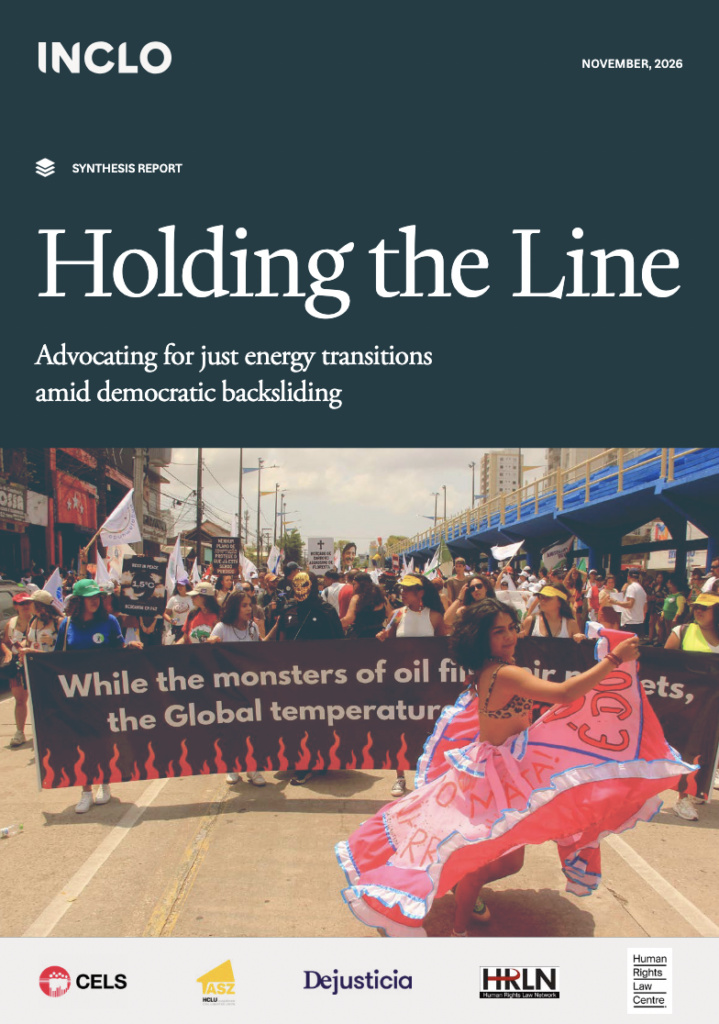
Takeaways from the third and final part of the webinar series Holding the Line.

By Marcela Madrid Vergara, Programme Coordinator for Climate and Environmental Justice
When talking about human rights and energy transition, it usually comes up as principles or obligations. But can we think of human rights as a tool to shape (and not only safeguard) just energy transitions? Is there space for a rights-based approach in contexts of democratic crisis?
Taking the recent advisory opinions as a starting point, the session “Human rights as a compass for just energy transitions” explored how to translate human rights principles and obligations into concrete practices amid democratic challenges. Speakers from Oxfam, the World’s Youth for Climate Justice, and INCLO members HRLC and HRLN discussed these questions that are central when thinking about a transition that transforms the old patterns of fossil extractivism.
Energy as a human right
If we keep in the current path, the energy transition risks becoming a mere technological shift (from fossil fuels to renewables), while reproducing the patterns of energy colonialism: a few powerful people benefitting from resource extraction in the South while energy keeps being inaccessible for hundreds of millions in the Global South. But this is not a problem of scarcity; it’s an issue of inequality: if just one year’s energy consumption of the wealthiest 1% were redistributed, it could meet the modern energy needs of all the people lacking electricity seven times over, according to Oxfam’s findings.
For Mateo Adarve Zuluaga, climate justice researcher at Oxfam, “There needs to be a paradigm shift where energy stops being a private good for profit, and turns into a public good and a human right.” If this happens, the transition could not only help mitigate CO2 emissions, but also offer an opportunity to reshape our economies around justice.
First, we need an understanding that tackling inequality is a necessary step to address the climate crisis. The reason is that “more equal societies demand less growth to meet basic needs and less energy to deliver wellbeing for all,” as revealed by Oxfam’s Unjust Transition report. Therefore, the importance of redistributing energy by creating an energy minimum that sets a floor of energy consumption (1.000 kw per person, per year) and cutting luxurious energy consumption from the richest individuals.
Human rights and energy transition: the courts have spoken
The harms caused by fossil fuels, a topic once reserved for scientific discussions, reached some of the world’s highest courts in 2025. Since the International Court of Justice and the Inter-American Court of Human Rights issued advisory opinions on climate change, lawyers and activists around the world have a powerful tool at hand to advocate for a human rights approach to climate mitigation.
There are two ways in which the advisory opinions clarified the link between human rights and energy transition, as summarized by Mariana Campos, member of the World’s Youth for Climate Justice. First, the courts reaffirmed the legal urgency of transitioning away from fossil fuels, reminding it has been widely proved by science that these are the main drivers of climate change, which poses a threat to human rights. In fact, the International Court of Justice made it clear that fossil fuel expansion could carry legal consequences for States.
The second link relates to the way in which the transition should take place. The Inter-American Court reminded states that any measure to mitigate the climate crisis must consider the impacts on communities and ecosystems. “This includes protecting human rights in the extraction of critical minerals, ensuring decent employment and social protection, and avoiding the reproduction of existing inequalities”, as Mariana Campos explained.
What progress has been made since then? Although that historic July 2025 is still recent, there are several examples of the advisory opinions already influencing laws, jurisprudence, and climate commitments around the world.
The ‘Hard Truths’ of fossil fuel exports
Australia is a good example of how the ICJ Advisory Opinion is having a concrete impact in a country’s pathway to a just transition. While the Australian government presents itself as a leader in the field and has made significant progress moving to renewables at home, it remains one of the world’s largest exporters of coal and gas.
Jack McLean, senior lawyer at HRLC, explained that the Government keeps supporting the fossil fuel industry by subsidizing fossil fuel infrastructure, providing environmental approvals for those projects, and failing to put in place any kind of process to control the harms that result from those emissions. The Government argues that emissions of fossil fuels exported out of Australia are not the country’s responsibility.
However, the ICJ advisory opinion came to debunk that idea and clarified that a country’s legal obligations extend to the consequences of fuels burned elsewhere. Along the same line, the High Court of Australia recently ruled against the expansion of a coal mine, arguing that its approval had failed to consider the impact of emissions generated when the exported coal is burned overseas.
Now, 10 Australian citizens -represented by the HRLC, Environmental Justice Australia, and Earthjustice- want to take this victory further. Under the ‘Hard Truths’ case, they have filed a complaint to the UN Human Rights Committee arguing the Australian government’s actions in facilitating and allowing fossil fuel exports causes harm to Australians by contributing to extreme climate events, which constitutes a breach of the country’s human rights obligations. The petition is simple: “We are asking the Committee to recommend that Australia take concrete action to stop its contribution to the harm, and we hope that it will set a precedent that exports can’t be just left off the table”, said Jack McLean. INCLO members have supported this claim arguing that Australia cannot claim to be a credible actor in the global climate fight while continuing to approve and subsidize new coal and gas export projects.
A transition without the people
But, what happens when the transition away from fossil fuels takes place in a context of repressed civic space? This has been the case in India, a country known for its high dependence on coal, where the transition to renewable energy is moving very fast. But at the same time, the government is making headlines for repressing climate activists, accusing them of jeopardizing India’s energy security by campaigning against fossil fuels.
That is not the only contradiction in India’s energy transition. According to Snigdha Tiwari, lawyer at the Human Rights Law Network (HRLN), communities and workers whose livelihoods depend on coal mining are the last to find out about its closure. “What people need is that before they (the government and companies) decide to close a coal mine, before the jobs disappear, they need to have the consultation, they need to have the re-skilling of those workers, and their livelihood protected”.
But even in this difficult scenario, there are examples of civil society coming together to reshape projects or demand accountability for the impact of unjust transition projects. One of these is the case of the Joshimath disaster in Uttarakhand, where a 2021 glacier break and 2023 land subsidence linked to hydropower projects killed over 200 people and damaged hundreds of homes. Local communities, indigenous groups, and climate activists mobilized and filed public interest litigation with HRLN’s support, pressuring the government at every level. As a result, the High Court forced the government to publish expert reports about the disaster that the authorities had kept secret. For Snigdha Tiwari, “The pressure from the Court, along with the pressure on the street, has to go hand in hand, together with the support of the media and the experts.”
Transformative experiences
In contrast to the Indian case, there are several examples of how, if done with a justice approach from the start, the energy transition can not only reduce emissions and energy poverty, but also spark deep social transformations. Mateo Adarve Zuluaga presented two cases from Oxfam’s report Pathways to a Fast and Just Energy Transition.
The first is the Energy Communities in Colombia, a model in which communities produce energy through renewable sources in their territories, own the profits, and distribute the benefits according to the community’s needs. The government supported historically marginalized communities, such as Indigenous or Afro-descendants, and embedded their sovereign jurisdiction and customs into the design of solar, wind, and geothermal projects. Some initiatives went further, involving former guerrilla members reintegrating into civilian life after the Peace Agreement.
The second is the Nga Awa Purua geothermal plant in New Zealand, an example of procedural justice through inclusive governance. Built on Māori land, the project shared not only economic benefits but also governance, including the Māori Land Trust on its board and in leadership. This engagement kept Māori voices central to decision-making, and profits have since been reinvested in schools, education, and healthcare.
Ideas for a human rights-based transition
In a context where democratic space is shrinking, it seems difficult to think of energy transitions based on justice principles. However, communities around the world are showing it is not impossible. The speakers outlined some strategies to keep human rights at the center of the energy transition:
- Mateo Adarve Zuluaga from Oxfam proposed that governments establish safeguards to ensure the private sector acts in the public interest, while advocating internationally for more equitable climate science scenarios that account for energy redistribution, consumption, production and ownership.
- HRLC’s Jack McLean advocated for incorporating international human rights law into domestic legislation and building climate jurisprudence through strategic litigation, using recent advisory opinions and court decisions to establish the climate crisis as an important human rights issue.
- Mariana Campos of World’s Youth for Climate Justice proposed challenging the narrative that climate advisory opinions are non-binding, emphasizing that many of the obligations they clarify are already binding under international treaties and customary international law.
- Snigdha Tiwari of HRLN advocated for including a mandatory human rights variable in environmental impact assessments for energy projects, ensuring meaningful community participation from the beginning and involving independent experts and civil society organizations.
Download the complete synthesis report here.
Download
Topics
Webinar Series