






Habitantes de asentamientos informales
Sudáfrica
Episodio 2 – Vivienda y resabios del apartheid.

English Transcript
Ir a la transcripción en español
Flor Coll, femiñetas: [00:00:00] You’re listening to In Our Hands, a podcast by INCLO and femiñetas about community responses to police violence.
Around the world, people are organizing against abuses by state forces—collectives that are putting the brakes on heavy-handed policing. After decades of failed police reforms, we ask: what new paths have emerged to keep us safe?
What options do we have to keep ourselves safe? We travel to uncover these forms of resistance and meet the people leading them. We learn from sex workers, from people criminalized for using drugs, and from users of the mental health system. This podcast grows out of INCLO’s publication *In Our Hands: Communities Uprooting Police Discrimination*. What happens when those who are supposed to protect us [00:01:00] instead come after us? We take the reins into our own hands.
Today we’re talking about South Africa—more specifically, the housing crisis left behind by apartheid. In 2024, two and a half million families were on the waiting list for state-subsidized housing.
At the current pace of public housing construction, that’s a seventy-year wait. To understand why, you have to know that today’s housing shortage is deeply rooted in decades of exclusion of South Africa’s non-white population. First came the colonial occupations by the Netherlands and the United Kingdom, and then, with the 1948 independence, apartheid was entrenched, officially placing power in the hands of white Afrikaners, descendants of settlers.
This system of racial segregation lasted into the 1990s. It [00:02:00] legally treated Black people and the mixed-race population as having fewer rights. In terms of urban planning, non-white communities were forced to live in segregated areas called townships, like Soweto in Johannesburg and Mitchells Plain in Cape Town.
News: Nelson Mandela was sworn in as President of South Africa, representing the African National Congress. Those words—the emotional voice of Nelson Mandela announcing the overwhelming victory—Nelson Mandela. The new president is about to take office, turning a new page in South Africa’s history.
The time has come to heal our wounds. The moment has come to bridge the divide that separates us.
Flor Coll, femiñetas: In 1994 the regime changed. Apartheid came to an end. Nelson Mandela was elected the first Black president of his country. South Africa rewrote its constitution—one of the most progressive in the world to this day. And yet [00:03:00] racial discrimination remains deeply entrenched in the system, in the economy, and in policing practices.
Today we’ll be speaking with Sherylle Dass, a lawyer at South Africa’s Legal Resources Centre, and with Kenneth Matlawe, a community organizer and educator with the Housing Assembly. Both organizations work at the intersection of the right to housing and police violence, and they wrote the article “In Our Hands,”
“Stopping police repression against housing and basic rights movements in South Africa.”
Sherylle Dass: I’m Sherylle Dass, Regional Director of the Legal Resources Centre.
Flor Coll, femiñetas: In South Africa, movements fighting for access to housing today face brutal responses: raids, demolitions, the seizure of personal belongings, arrests, and militarized interventions.
Sherylle Dass: The housing crisis and land reform more broadly in South [00:04:00] Africa have been shaped in many ways by apartheid and colonial policies.
For me, there are two issues that remain problematic. The first is apartheid-era land-use planning laws, which created whites-only areas in lucrative financial hubs close to economic opportunities, while people of color were stripped of their property rights and forced to live in under-resourced areas far from those opportunities.
During apartheid, Black and racialized people were stripped of their property rights. They had no right to housing.
Nor did they have the right to protection from violent evictions, as you know. After 1994, these problems persisted.
The second, and I think the most troubling, is that during apartheid there was a deliberate, strategic policy to dehumanize and criminalize Black people.
[00:05:00] The common term used to instill fear among white South Africans was the phrase coined as “swart gevaar,” meaning “black danger.” Black people were portrayed as dangerous criminals rather than as human beings. These laws and policies reflected the othering of Black and racialized people.
News: Cape Town’s anti-land invasion units and security agencies have come under widespread criticism following the eviction of residents from the Empoweni informal settlement in Kalisha.
Sherylle Dass: Like this.
We’ve reached a point in this post-democracy where, as recently as 2020 during the COVID-19 pandemic, members of the Housing Assembly were violently evicted by [00:06:00] armed police officers from an informal settlement in Khayelitsha, Cape Town.
One of the residents, a member of the Housing Assembly, was violently dragged out of his shack while he was bathing, and security officers tore down and demolished his home using crowbars and other tools.
Flor Coll, femiñetas: These scenes clearly brought to mind the evictions and forced removals of the apartheid era.
Sherylle Dass: And the reasons given for this eviction were very similar to the justifications the apartheid government used to demolish Black people’s homes.
Flor Coll, femiñetas: South Africa is one of the few countries that enshrines the right to housing in its constitution. However, it is still far from being a right that is actually guaranteed. In this context, grassroots organizations are crucial to keeping up the demands of [00:07:00] people whose rights are not being respected.
Sherylle Dass: South Africa’s Constitution is the most progressive in the world. In fact, I’m very proud to say that in today’s context. It not only guarantees civil and political rights, but also makes social and economic rights progressively realizable. So the right to housing is a progressively realizable right.
It’s guaranteed, but it’s subject to the government’s available resources. Section 26 of the Constitution goes beyond simply granting housing rights. It also provides protection against arbitrary dispossession and eviction from property without due process. That was important—and I think it still is—when we talk about undoing apartheid-era laws.
This provision of the Constitution is a direct reflection of that.
Flor Coll, femiñetas: Sherril says a housing crisis isn’t solved with bricks and mortar [00:08:00] alone. First and foremost, you build political will—something successive governments have failed to show.
Sherylle Dass: We believe they can do far more than that. For one thing, they can stop using the police as a tool to justify the failure to provide adequate housing—or at the very least have a plan to deliver it.
The backlog, as it stands today, is about seventy years. That means the South African government won’t be able to provide housing or truly reduce the wait for the people currently on the housing list over the next seventy years. To me, that isn’t progress.
Without a complete paradigm shift, we believe that as long as Black and racialized people are viewed as violent and dangerous, any intervention—even with human-rights training—will be purely cosmetic.
News: [00:09:00] These protests began at three o’clock this morning. There have been major traffic jams because of them, but they said they’re about to discuss the issue and that they plan to meet with the Cape Town authorities.
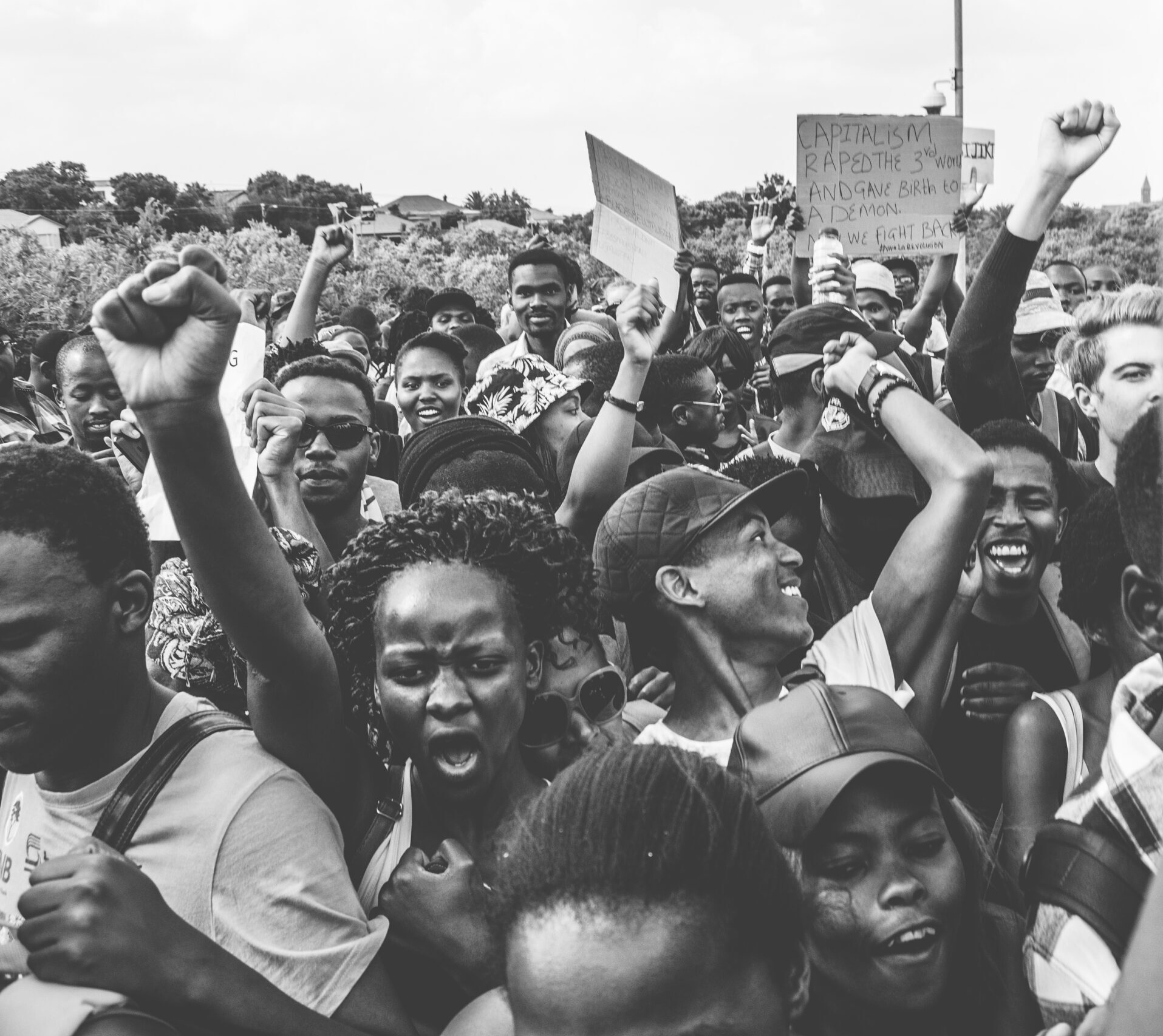
Flor Coll, femiñetas: In the distant, impoverished neighborhoods known as townships, it is grassroots movements that are facing state violence.
They oppose the demolition of their homes by militarized forces, the seizure of their belongings, and arbitrary arrests. The Housing Assembly is one of these organizations that, in addition to coordinating assemblies and demonstrations, created a political school to educate residents about their rights.
Kenneth Matlawe: My name is Kenneth Matlawe. I’m a member of the Housing Assembly’s executive committee, but [00:10:00] my main role is political education. I’ve been with the organization for fifteen years and have held different positions, including political education organizer. So I mainly focus on organizing workshops, political schools, discussion forums, and the like.
Flor Coll, femiñetas: In a country where land distribution is still shaped by racism, the people who organize are mostly Black and impoverished communities. And it’s no coincidence that they face police violence disproportionately.
Kenneth Matlawe: The first thing for us as activists—the most important thing—is that we feel the police presence has become more a form of intimidation than protection for people’s safety. Their presence at protests only fills us, as activists, with fear [00:11:00] rather than a sense of protection, because the police are supposed to be there to protect everyone.
News: RDP houses are falling apart, informal settlements are growing, and mass evictions are taking place, while at the same time there are ongoing debates about land expropriation without compensation.
Kenneth Matlawe: There’s a specific example that happened in Malmesbury. It was during the COVID pandemic, under the lockdown regulations. So at first we’d arranged a meeting with the local municipal councillor. They called us in for a meeting, but then we said we didn’t want anything to be discussed behind closed doors.
We wanted the community to be there, so we went along with the municipal officials to hear what they had planned for the community.
Flor Coll, femiñetas: [00:12:00] But the municipality had other plans and called the police, claiming that the neighbors were violating social distancing rules through a violent protest.
Kenneth Matlawe: We didn’t do anything violent there, but they fired stun grenades and rubber bullets at us and arrested us. Everyone was running in every direction. So it wasn’t until later that night that we found out who had been arrested, who had been injured, and who had managed to get away—because all three of those things happened.
One of my friends was injured, and then, of course, they arrested twenty of them — even a passerby, someone who wasn’t even part of the protest.
Flor Coll, femiñetas: In this way, taking part in protests comes at a cost, which becomes yet another obstacle to securing the very right people are fighting for.
Kenneth Matlawe: Most of the guys [00:13:00] were released that same night, but nine of them stayed in custody until the next day and were then formally charged with—let me see if I’m saying this right—disturbing public order and, of course, violating the lockdown rules. It took more than three years of back-and-forth, going to court hearings and all that, and over time some of the guys got discouraged.
They were no longer interested in the organization because now they have criminal records: their fingerprints were taken and they were fully entered into the system. Now they show up in the police database, and that’s considered a criminal record—something that, when applying for jobs, could even count against someone.
Flor Coll, femiñetas: When the Housing Assembly was founded in 2009, there were relentless evictions in the western part of Cape Town. Faced with repeated crackdowns, Kenneth and his colleagues saw the urgent need to [00:14:00] create a political school for their community.
Kenneth Matlawe: We feel that, as communities, we’ve been demoralized, depoliticized, and disorganized. Instead of addressing the root causes of protests—like the lack of housing or unemployment—the state responds with repression. So for us, to do that—I know it’s a very broad statement—but to make that statement understandable to the ordinary citizen, for us, that is the most powerful weapon we can give a community, so it can understand why and how things happen the way they do.
Secondly, for us, political education is also about making it clear that we can see the militarization of the police. When the police arrive at a protest, they look like the army. So the Housing Assembly’s political school [00:15:00] is a platform where we recognize that all of us come from different political, economic, social, and cultural backgrounds.
You know, a nation as diverse as South Africa, with a history—our history of racial apartheid—we know we come from different backgrounds. So with those different backgrounds, we need a space where we can all get on the same page from time to time. We join this struggle for housing not because we think alike, but because the conditions bring us here.
One of the most profound things to come out of the Housing Assembly, or the Housing Assembly’s political school, is that people are connecting the dots.
Flor Coll, femiñetas: Teaching people to recognize how and where the threads of exclusion are tied to state violence is perhaps the Housing Assembly’s most powerful weapon. It helps communities protect themselves better and demand, through more avenues, what is rightfully theirs—what ultimately amounts to justice. In [00:16:00] post-apartheid South Africa, justice begins with something as basic as it is essential: having a roof over your head.
You’ve just listened to In Our Hands, a podcast by INCLO and femiñetas. We thank the Housing Assembly and the Legal Resources Centre for taking part in the podcast and for helping communities like ours take matters into our own hands. This podcast is based on INCLO’s publication In Our Hands.
To listen to the other episodes, visit inclo.net and femiñetas’ audio platforms.
Transcripción en Español
[00:00:00]
Flor Coll, femiñetas: Estás escuchando En nuestras manos, un podcast de INCLO y femiñetas sobre respuestas ciudadanas a la violencia policial. En todo el mundo hay personas que se organizan frente a los abusos de las fuerzas del estado, colectivos que le ponen un freno a la mano dura. Después de décadas de reformas policiales fallidas, nos preguntamos: ¿qué caminos surgieron para nuestra seguridad?
¿Qué opciones existen para cuidarnos? Viajamos para descubrir estas resistencias y conocer a quienes las lideran. Aprendemos de trabajadoras sexuales, personas criminalizadas por consumir drogas, usuarias del sistema de salud mental. Este podcast surge de la publicación de INCLO En nuestras manos: comunidades que arrancan de raíz la discriminación policial. ¿Qué pasa cuando los que nos tendrían que [00:01:00] cuidar nos persiguen? Tomamos las riendas en nuestras manos.
Hoy hablamos de Sudáfrica, más específicamente de la crisis de vivienda que dejó el apartheid. En 2024 había dos millones y medio de familias en lista para una vivienda subsidiada por el Estado.
Con el ritmo actual de construcción pública de casas son setenta años de espera. Para entender ese fenómeno hay que saber que la falta de viviendas actual está profundamente arraigada en décadas de exclusión de la población no blanca en Sudáfrica. Primero, por las ocupaciones coloniales de los Países Bajos y del Reino Unido, y después, con la independencia de 1948, se consolidó el apartheid que ponía oficialmente el poder en manos de los blancos afrikááners, descendientes de colonos.
Este régimen de segregación racial corrió hasta los años noventa. Establecía [00:02:00] legalmente como inferiores en derechos a la gente negra y a la población mestiza. En términos de planificación territorial, las poblaciones no blancas fueron forzadas a vivir en zonas segregadas llamadas townships, como Soweto en Johannesburgo y Mitchells Plain en Ciudad del Cabo.
noticiero: Nelson Mandela was sworn in as the president of South Africa- For the African National Congress. Esas palabras, la voz emocionada de Nelson Mandela anunciando la arrolladora victoria- Nelson Mandela. O novo presidente vai tomar posse virando uma nova página na história da África do Sul.
The time for the healing of the wounds has come. The moment to bridge the chasm that divides us has come.
Flor Coll, femiñetas: En 1994 cambia el régimen. Es el fin del apartheid. Nelson Mandela fue electo primer presidente negro de su país. Sudáfrica reescribe su constitución, una de las más progresistas del mundo hasta el día de hoy. Sin embargo, la [00:03:00] discriminación racial sigue profundamente instalada en el sistema, en la economía y en las prácticas policiales.
Hoy hablaremos con Sherylle Dass, abogada del Legal Resources Centre de Sudáfrica, el Centro de Recursos Legales, y con Kenneth Matlawe, organizador popular y docente de la Housing Assembly. Ambas organizaciones trabajan en la intersección del derecho a la vivienda y la violencia policial y escribieron el artículo de En nuestras manos,
“Frenar la represión policial contra los movimientos por la vivienda y los derechos básicos en Sudáfrica.”
Sherylle Dass: Soy Sherylle Dass, directora regional del Centro de Recursos Legales.
Flor Coll, femiñetas: En Sudáfrica, los movimientos que militan por el acceso a la vivienda hoy enfrentan respuestas brutales: redadas, demoliciones, confiscación de bienes personales, arrestos e intervenciones militarizadas.
Sherylle Dass: La crisis de la vivienda y la reforma agraria en general en Sudáfrica han estado [00:04:00] marcadas por el apartheid y las políticas coloniales de diversas maneras.
Para mí hay dos cuestiones que siguen siendo problemáticas. La primera son las leyes de ordenación territorial del apartheid, que crearon zonas exclusivas solo para blancos en centros financieros lucrativos cercanos a las oportunidades económicas, mientras que las personas de color fueron privadas de sus derechos de propiedad y obligadas a vivir en zonas con escasos recursos, lejos de las oportunidades económicas.
Durante el apartheid, a las personas negras y racializadas se las privó de sus derechos de propiedad. No tenían derecho a la vivienda.
Tampoco tenían derecho a protección contra los desalojos violentos como saben. Después de 1994, estos problemas persisten.
La segunda, y creo que la más preocupante, es que durante el apartheid hubo una política concertada y estratégica para deshumanizar y criminalizar a las personas negras.[00:05:00]
El término común utilizado para infundir miedo entre los sudafricanos blancos fue el término acuñado como “swart gevaar”, que significa peligro negro. A las personas negras se las representaba como criminales peligrosos y no como seres humanos. Estas leyes y políticas reflejaban la otredad de las personas negras y racializadas.
noticiero: Las unidades contra la invasión de tierras y los organismos de seguridad de Ciudad del Cabo han sido objeto de críticas generalizadas tras el desalojo de residentes del asentamiento informal de Empoweni en Kalisha.
Sherylle Dass: Así es que que llegamos a un punto en una posdemocracia y tan recientemente como en 2020, durante la pandemia del COVID-19, cuando integrantes de la Housing Assembly fueron desalojados violentamente por [00:06:00] agentes de policía armados en un asentamiento informal en Khayelitsha, Ciudad del Cabo.
Uno de los residentes, quien era miembro de la Housing Assembly, fue arrastrado violentamente fuera de su choza mientras se bañaba y los agentes de seguridad derribaron y demolieron su hogar utilizando palancas y otros instrumentos.
Flor Coll, femiñetas: Estas escenas recordaban claramente a los desalojos y las expulsiones de la era del apartheid.
Sherylle Dass: Y las razones esgrimidas durante este desalojo fueron muy similares a las justificaciones que el gobierno del apartheid dio para demoler las viviendas de la población negra.
Flor Coll, femiñetas: Sudáfrica es de los pocos países que tiene el derecho a la vivienda en su constitución. Sin embargo, dista mucho de ser un derecho efectivamente garantizado. En este contexto, las organizaciones de base son de suma importancia para sostener los reclamos de la [00:07:00] población cuyos derechos no son respetados.
Sherylle Dass: La constitución sudafricana es la más progresista del mundo. De hecho, me enorgullece mucho afirmarlo en el contexto actual. No solo garantiza los derechos civiles y políticos, sino que también hace que los derechos sociales y económicos sean progresivamente realizables. Entonces, el derecho a la vivienda es un derecho progresivamente realizable.
Está garantizado, pero está sujeto a los recursos disponibles del gobierno. El artículo veintiséis de la Constitución va más allá de simplemente otorgar derechos de vivienda. También ofrece protección contra la desposesión y el desalojo arbitrarios de una propiedad sin el debido proceso. Esto fue importante y creo que es importante cuando hablamos de reparar las leyes del apartheid.
Esta disposición de la Constitución es un reflejo directo de eso.
Flor Coll, femiñetas: Sherrylle dice que una crisis habitacional no se soluciona solo con ladrillos y cemento. En primer lugar, [00:08:00] se construye voluntad política, cosa que los sucesivos gobiernos no han demostrado.
Sherylle Dass: Creemos que pueden hacer mucho más que eso. Por un lado, pueden dejar de utilizar a la policía como un aparato para justificar la falta de provisión de vivienda adecuada o al menos tener un plan para brindarla.
El retraso, tal como está hoy, es de unos setenta años. Eso significa que el gobierno sudafricano no podrá proporcionar vivienda ni reducir realmente la espera de las personas que actualmente están en la lista para una vivienda en los próximos setenta años. Eso para mí no es progreso.
Sin un cambio de paradigma completo, creemos que la forma en que se percibe a las personas negras y racializadas como violentas y peligrosas hará que cualquier intervención, incluso con capacitación en derechos humanos, sea meramente cosmética. [00:09:00]
noticiero: Estas protestas comenzaron a las tres de la madrugada de hoy. Se han producido grandes atascos de tráfico debido a estas protestas, pero mencionaron que están a punto de discutir el tema y que planean reunirse con las autoridades de Ciudad del Cabo.
Flor Coll, femiñetas: En los barrios alejados y empobrecidos, llamados townships, quienes enfrentan la violencia del Estado son los movimientos de base.
Se oponen a la destrucción de sus viviendas por parte de fuerzas militarizadas, al secuestro de sus pertenencias y a las detenciones al voleo. La Housing Assembly es una de estas organizaciones que además de coordinar asambleas y manifestaciones, creó una escuela política para educar a los y las residentes sobre sus derechos.
Kenneth Matlawe: Mi nombre es Kenneth Matlawe. Soy miembro del comité ejecutivo de la [00:10:00] Housing Assembly, pero mi función principal es la educación política, ya que llevo quince años en la organización y he ocupado diversos cargos, entre ellos el de organizador de educación política. Por eso me dedico principalmente a organizar talleres, escuelas políticas, foros de debate y demás.
Flor Coll, femiñetas: En un país donde la distribución de la tierra sigue marcada por el racismo, quienes se organizan son, en su mayoría, comunidades negras y empobrecidas. Y no es casual que se enfrenten de manera desproporcionada a la violencia de parte de la policía.
Kenneth Matlawe: Lo primero para nosotros como activistas, lo más importante es que sentimos que la presencia de la policía se ha convertido más en una forma de intimidación que en una protección para la seguridad de la gente. Su presencia en las protestas solo nos infunde miedo a nosotros como [00:11:00] activistas, en lugar de una sensación de protección, porque la policía está ahí para proteger a todos.
noticiero: Las viviendas del RDP se están desmoronando, los asentamientos informales van en aumento, se están produciendo desalojos masivos, mientras que al mismo tiempo también hay debates en curso sobre la expropiación de tierras sin compensación.
Kenneth Matlawe: Hay un ejemplo concreto que ocurrió en Malmesbury. Fue durante la pandemia de COVID con las normas del confinamiento. Así que inicialmente habíamos concretado una reunión con el concejal municipal local. Nos llamaron para una reunión, pero entonces dijimos que no queríamos que se discutiera nada a puerta cerrada.
Queríamos que la comunidad estuviera presente, así que fuimos caminando los funcionarios del municipio a escuchar lo que tenían preparado para la comunidad. [00:12:00]
Flor Coll, femiñetas: Pero el municipio tenía otros planes y llamó a la policía bajo el pretexto de que los vecinos estaban infringiendo las normas de distanciamiento social mediante una protesta violenta.
Kenneth Matlawe: No cometimos ningún acto violento allí, pero nos dispararon con granadas aturdidoras y balas de goma y nos arrestaron. Todo el mundo corría en todas direcciones. Así que no fue hasta más tarde esa noche que nos enteramos de quiénes habían sido arrestados, quiénes habían resultado heridos y quiénes habían logrado escapar, porque sucedieron esas tres cosas.
Uno de mis compañeros resultó herido y luego, por supuesto, arrestaron a veinte de ellos, incluso a un transeúnte, alguien que ni siquiera formaba parte de la protesta.
Flor Coll, femiñetas: De este modo, participar en protestas tiene un costo que se vuelve un obstáculo más en la obtención del derecho por el que se reclama.
Kenneth Matlawe: La mayoría de los compañeros fueron [00:13:00] liberados esa misma noche, pero nueve de ellos permanecieron detenidos hasta el día siguiente y luego fueron acusados oficialmente de, a ver si lo digo bien, alteración del orden público y por supuesto, de infringir la normativa de confinamiento. Llevó más de tres años de idas y vueltas, de asistir a audiencias judiciales y demás, y con el tiempo algunos compañeros se desanimaron.
Ya no estaban interesados en la organización porque ahora tienen antecedentes penales, por lo que han tomado las huellas dactilares y quedaron completamente registrados. Ahora figuran en el sistema policial y eso se considera un antecedente criminal que en las solicitudes de empleo podría incluso jugar en contra de una persona.
Flor Coll, femiñetas: Cuando nace la Housing Assembly en 2009, había incesantes desalojos en el oeste de Ciudad del Cabo. Ante los repetidos episodios de represión, Kenneth y sus colegas vieron la [00:14:00] urgencia de crear una escuela política para su comunidad.
Kenneth Matlawe: Sentimos que como comunidades nos han desmoralizado, nos han despolitizado y nos han desorganizado. En lugar de abordar las causas de fondo de protestas, como la falta de vivienda o el desempleo, el Estado responde con represión. Así que para nosotros hacer tal, sé que es una afirmación muy amplia, pero hacer que esta afirmación sea comprensible para el ciudadano común, para nosotros, esa es la arma más poderosa que podemos darle a una comunidad, para que pueda entender por qué y cómo las cosas suceden de la manera en la que suceden.
En segundo lugar, también para nosotros, la educación política consiste en dejar claro que podemos ver la militarización de la policía. La policía, cuando llega a una protesta, parece el ejército. Así que la escuela política de la Housing Assembly [00:15:00] es una plataforma en la que sabemos que todos nosotros venimos de diversos orígenes políticos, económicos, sociales y culturales.
Ya sabes, una nación tan diversa como Sudáfrica, con una historia, una historia de apartheid racial tan diversa como la nuestra, sabemos que venimos de orígenes diversos. Así que con orígenes diversos tenemos que tener un espacio donde todos podamos ponernos en sintonía de vez en cuando. Nos sumamos a esta lucha por la vivienda, no porque pensemos igual, sino porque las condiciones nos traen aquí.
Una de las cosas más profundas que surgen de la Housing Assembly o de la escuela política de la Housing Assembly es que la gente está conectando los puntos.
Flor Coll, femiñetas: Enseñar a identificar cómo y dónde se atan los cabos de la exclusión con la violencia de Estado es quizás el arma más contundente de la Housing Assembly. Permite protegerse mejor y reclamar por más canales lo que corresponde, que en definitiva es [00:16:00] justicia. En Sudáfrica posapartheid, esa justicia empieza por algo tan básico como esencial: tener un techo.
Acabás de escuchar En nuestras manos, un podcast de INCLO y femiñetas. Agradecemos a la Housing Assembly y al Legal Resources Centre por su participación en el podcast y por ayudar a las comunidades a que tomemos las riendas en nuestras manos. Este podcast se basa en la publicación In Our Hands de INCLO.
Para escuchar los demás episodios de En nuestras manos, puedes buscarlos en inclo.net y en las plataformas de audio de femiñetas.
A podcast on community strategies against police violence
Podcast in Spanish with English transcript


Listen now on your favourite platform